
5 Practical Benefits of Wireless LED Lighting and Where It’s Used Most Effectively
Wireless LED lighting has become a frequent topic in commercial and industrial lighting conversations, not because it replaces traditional systems, but because it solves particular problems. When projects are constrained by time, access, or disruptions, reducing or eliminating wiring can accelerate lighting upgrades.
At LED Stick Company, wireless LED lighting is approached as a practical tool that speeds installation and limits disruption. It supports flexible layouts, while paired with wired solutions where consistency and longevity matter more. That execution-first approach helps teams control labor, timelines, and long-term costs.
Talk to our team about where wireless LED lighting fits into your lighting plan.
To understand where wireless LED lighting adds the most value, it helps to look at the benefits individually and how they show up in different spaces.
1. Faster Installation When Time Is the Constraint
The most immediate benefit of wireless LED lighting is installation speed. By reducing wiring requirements, projects often move from start to finish with fewer steps and less coordination.
Wireless LED lighting is invaluable when:
Install windows are short
Facilities remain occupied during upgrades
Electrical access is limited
Phased installations are required
In retrofit scenarios, avoiding conduit runs or control wiring can significantly reduce labor hours. That time savings becomes especially valuable in active facilities where downtime carries a real cost.
2. Flexibility in Spaces that Change Over Time
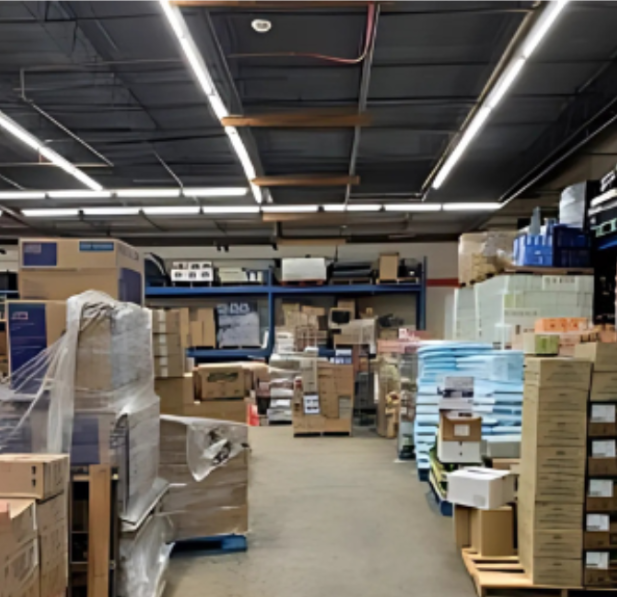
Many facilities are not static. Storage layouts shift, work zones move, and temporary areas become permanent or disappear entirely. Wireless LED lighting supports that kind of change without requiring new electrical work each time.
This flexibility is commonly used in:
Warehouses with changing racking layouts
Storage facilities with reconfigured aisles
Maintenance and staging areas
Temporary or seasonal spaces
Wireless LED lighting allows teams to reposition or adjust lighting without treating every change as a construction project.
3. Cleaner Retrofits in Finished or Occupied Spaces
Running new wiring in finished environments often disrupts the lighting itself. Ceiling access, patching, and coordination with other trades can extend project timelines.
Wireless LED lighting minimizes that disruption by:
Reducing invasive electrical work
Limiting ceiling or wall access
Keeping work areas cleaner during upgrades
This makes wireless LED lighting a practical option in offices, corridors, storage rooms, and other spaces where maintaining daily operations is a priority.
4. Practical Solutions for Low-Use and Supplemental Areas
Not every space requires permanent, high-output lighting infrastructure. Wireless LED lighting is often used for occasional, task-based, or supplemental lighting needs.
Common applications include:
Storage rooms and closets
Utility and mechanical spaces
Inspection or task lighting
Temporary work zones
In these environments, wireless LED lighting delivers adequate illumination without the cost or complexity of permanent wiring.
5. Control Capabilities Without Additional Wiring

One of the most valuable aspects of wireless LED lighting is control flexibility. Wireless controls reduce the need for additional control wiring while still allowing lighting systems to respond to how spaces are used.
Wireless LED lighting systems may support:
Occupancy-based operation
Zoning and grouping changes
Schedule adjustments
Layout-based lighting updates
This is especially useful in retrofit projects where running new control wiring would be disruptive or costly.
How Wireless LED Lighting Is Used Across Different Environments
Wireless LED lighting is used in many types of facilities, but its role varies depending on how the space operates.
In warehouses and storage facilities, wireless LED lighting is often used in low-traffic areas or as supplemental lighting where layouts change frequently.
In manufacturing environments, it may support task lighting, inspection zones, or transitional spaces rather than core production floors.
In commercial buildings, wireless LED lighting is commonly applied in finished spaces where minimizing disruption is a priority.
Across these environments, wireless LED lighting works best when it complements rather than replaces wired lighting systems.
Understanding the Tradeoffs
While wireless LED lighting offers tangible benefits, it also presents considerations for long-term planning.
Battery-powered systems require ongoing maintenance. Output levels may not match hardwired fixtures. Performance consistency can vary depending on usage and environment. According to the U.S. Department of Energy, LED technology in general uses at least 75 percent less energy and lasts up to 25 times longer than traditional incandescent lighting, but those performance advantages depend heavily on proper application and system design.
Many successful projects use a hybrid approach, applying wireless LED lighting where flexibility and speed matter most, and relying on wired fixtures where consistency, output, and longevity are critical.
Using Wireless LED Lighting as a Strategic Tool
Wireless LED lighting delivers the most value when it’s used intentionally. Treating it as a solution for every space can introduce unnecessary maintenance and cost. Using it selectively allows teams to capture its benefits without sacrificing reliability.
Projects tend to perform better when lighting decisions are driven by:
Frequency of space usage
Required consistency of illumination
Level of flexibility the space demands
Expected lifespan of the lighting solution
Matching the lighting approach to the reality of the space keeps costs predictable and reduces surprises after installation.
Where Execution Makes the Difference
Even the right lighting technology can fall short if execution breaks down. Product availability, application fit, and planning all play a role in whether wireless LED lighting delivers on its promise.
At LED Stick Company, we focus on real-world use cases, identifying where it speeds up installs, reduces disruption, and where a wired solution still makes more sense.
Making Smarter Lighting Decisions
Wireless LED lighting offers meaningful benefits when applied in the proper context. Faster installs, greater flexibility, and cleaner retrofits make it a valuable tool for many projects.
Understanding how it’s used across different environments allows teams to make informed decisions that balance speed, cost, and long-term performance.
Get in touch with our team to learn how wireless LED lighting fits into your next project.